In this interview, Miroslav Florek explains how his system works, what problems it solves, and what the future of the construction industry looks like from his perspective.
1. “What is SMARTPANEL, what makes it so unique, and why drill into such thin walls?”
SMARTPANEL is a next-generation building system consisting of precision-manufactured reinforced concrete panels, complemented by a number of patented features. It functions like a precise jigsaw puzzle, enabling fast, high-quality construction without the need for on-site improvisation.
The prefabricated elements are manufactured to a high degree of finish, leaving only minimal work to be done on-site. As a result, the entire construction process is significantly faster and more precise, meaning minimal improvisation and minimal potential errors!
In addition, the prefabricated panels come factory-fitted with thermal insulation that eliminates thermal bridges, resulting in an energy-efficient building with a clean design and a healthy indoor environment.
You can see SMARTPANEL in action, for example, in the new development project Rezidence U Tvrze in Prague’s Malešice district, where this system forms both the load-bearing and interior partition structures. The interior partitions between rooms are constructed using gypsum fiber boards, which—compared to standard drywall—are nearly twice as heavy, six times stronger, and have significantly better acoustic properties.
Specifically: the sound attenuation of our partitions reaches 44–48 dB, while the standard requires only 42 dB. The structure consists of a steel grid with acoustic insulation, clad with panels that are additionally glued at the butt joints and bonded into a single monolithic unit, eliminating the risk of cracks. The result is strong, quiet, and easily customizable walls to which standard household fixtures can be safely anchored.
Regarding drilling:
- You can easily drill into load-bearing walls made of SMARTPANEL using a standard SDS drill.
- For partitions made of gypsum fiberboard, ordinary screws are sufficient; without anchors, they can support up to 15 kg, and with anchors, up to 50 kg.
2. “We often hear about ‘rapid construction’ projects that may be of low quality. How is it possible that SMARTPANEL allows for rapid construction without compromising on quality?”
It is not the speed of construction that leads to poor quality, but other factors. In general, with conventional new construction, compromises are often made during the construction process itself. This is due, for example, to imprecise joints, cracks, poor sealing, or acoustic issues. SMARTPANEL works differently.
The key is a combination of engineering precision and thorough preparation: each component is manufactured with an accuracy of one-tenth of a millimeter, and during assembly, it is guided from a crane using special anchors with an accuracy of ±0.5 mm. This level of precision eliminates compromises on-site and human error, ensuring a perfect fit of all components without the need for additional adjustments. A practical example is a single-family home in Kolomuty, where the structural shell alone took just 10 hours to complete.
Watch a video of the construction process HERE
Another example is the Rezidence U Tvrze development project in Malešice, Prague, which includes 9 units with underground garages. The structural shell, including the underground garages, will be completed in approximately 4 months—at a rate of one floor per month. This clearly demonstrates that SMARTPANEL is effective even in the construction of larger residential projects.
Another advantage is the material itself—reinforced concrete panels that do not deform due to moisture or temperature changes. Unlike conventional materials (such as drywall or wood), which “expand and contract” and cause joints to crack, SMARTPANEL holds firmly and cleanly, without the need to conceal joints with trim or exposed seams. After installation, all panels are grouted with a special cement grout, which unifies the entire house into a single monolithic structure. The result is a strong and stable structure that does not crack even under load and will last for generations.
3. “What about SMARTPANEL and soil settlement beneath the building’s foundation? That’s also one of the reasons why, for example, the joints between the ceiling and the wall crack.”
Cracking at joints due to soil settlement is a common problem, but it occurs only under certain conditions. It arises primarily when the soil beneath the foundation is unstable or compresses unevenly. If the foundations are not made of well-interlocked precast reinforced concrete elements or monolithic concrete, shear forces develop between the individual elements. One part of the structure settles more than the other, causing cracks in the joints and in the plaster.
Another major cause of the problem is often a lack of technical discipline during foundation construction. For every project, a structural engineer calculates the required bearing capacity of the foundation bed—that is, the soil surface on which the foundations are laid. If it is determined that the soil does not have sufficient bearing capacity, it is necessary to either dig deeper or reinforce the soil in some other way. However, this is costly, so this step is often bypassed.
The problem can be even more complex: the soil beneath the structure may have varying degrees of swelling in different locations. This is particularly evident during seasonal changes in the groundwater level and the subsequent drying and wetting of the soil. Unevenly distributed soil layers then cause constant movement of the structure. To prevent these risks, a thorough geological survey must be conducted before construction begins.
Another common mistake is allowing the foundation joint to become saturated, for example, due to rain or groundwater. Clay-rich rocks are particularly problematic, as they swell when wet and shrink when dry. If this situation is not addressed, an unstable subsoil develops, which subsequently causes cracks.
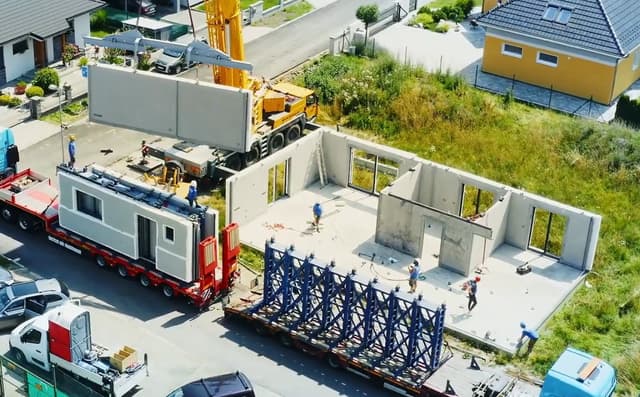
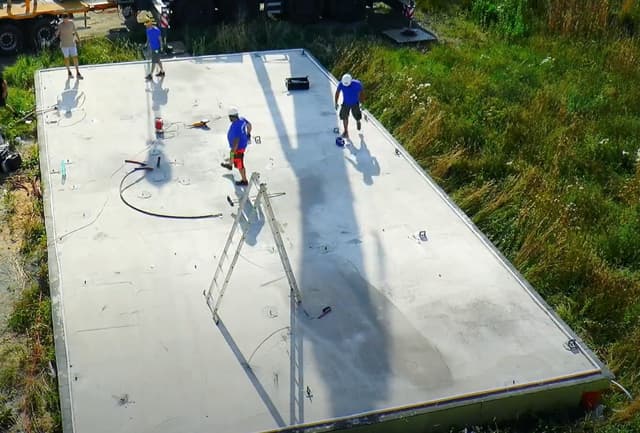
Photographs from the construction of a single-family home.
With the SMARTPANEL system, the risk of cracking is minimized for several reasons:
- The structure is monolithic or monolithized, ensuring maximum strength.
- The ceilings are constructed as a single, continuous slab, which adds rigidity to the structure.
- After assembly, the precast reinforced concrete elements are grouted with cement grout, which bonds everything into a single unit.
- The foundation joint is always carefully inspected and prepared in accordance with prescribed requirements.
A specific example is the U Tvrze Residence project in Malešice, where:
- A geological survey was conducted prior to construction.
- The foundation joint is located on dry, stable bedrock.
- A 60-cm-thick monolithic reinforced concrete slab was used to support the entire building on a single level.
- The entire building is constructed from SMARTPANEL.
4. “How is it possible that SMARTPANEL maintains ideal humidity levels indoors? Is there really no risk of window condensation or mold growth?”
Condensation on windows and mold growth are very common problems in most older and newer buildings.
Regular ventilation and heating are recommended, which address the immediate problem but not its root cause—the problem lies in the very foundation of the building itself.
Most indoor humidity is caused by cold surfaces on which warm air condenses. It’s similar to how water condenses on a glass of cold drink in the summer. If the walls aren’t sufficiently insulated or have thermal bridges, moisture condenses on them and can cause mold.
In conventional buildings, people often rely on high water vapor diffusion—the idea that moisture will somehow “dry out” and escape through the walls. However, this results in dry and unhealthy indoor air. In winter, people often suffer from irritated mucous membranes and other health problems.
The traditionally recommended relative humidity for indoor air is 60%, which is considered a compromise between the health of the building and that of its occupants. In the summer, when people breathe most easily, the humidity can reach as high as 90%. This level is the healthiest for humans, but conventional buildings would deteriorate during the heating season at such humidity levels, and mold would grow directly on the walls.
Recent scientific research related to the COVID-19 pandemic has shown that most pathogens, such as viruses and bacteria, lose their virulence much more quickly at 90% relative humidity. The reason is that the droplets spread by infected people into the surrounding air dry out quickly in dry air, and the dried pathogens become nonviable. Conversely, in a more humid environment, pathogens remain in the droplets for longer, where the conditions are unfavorable to them and their viability decreases. This means that high humidity is not only healthier for humans but also more effective in combating the spread of disease.
With SMARTPANEL, we address humidity through four key pillars:
- Exterior thermal insulation: Reinforced concrete panels are always insulated on the exterior, ensuring that their surface remains warm and preventing moisture condensation.
- Elimination of thermal bridges: Thanks to sophisticated design details, such as offset window installation or balcony connections without cooling ribs, the interior and exterior environments are maximally separated.
- High diffusion resistance: The panels have high diffusion resistance, which means that moisture is not drawn out of the interior faster than the moisture generated by daily activities and occupancy can replenish it. The necessary humidity thus remains in the environment at a level essential for healthy breathing.
- Stable indoor climate: Air moisture accumulates in the load-bearing structures, and in the event of sudden ventilation during the heating season—when there is a rapid exchange of air with dry outdoor air—the missing moisture is replenished in the new air from these structures.
The stability of the indoor environment in the SMARTPANEL system is achieved because the load-bearing structure is completely within a warm, heated space and is wrapped in an insulating layer on the outside. This simple yet effective principle ensures that the entire structure maintains a temperature close to that of the interior. All surfaces are therefore warm enough to prevent moisture condensation.
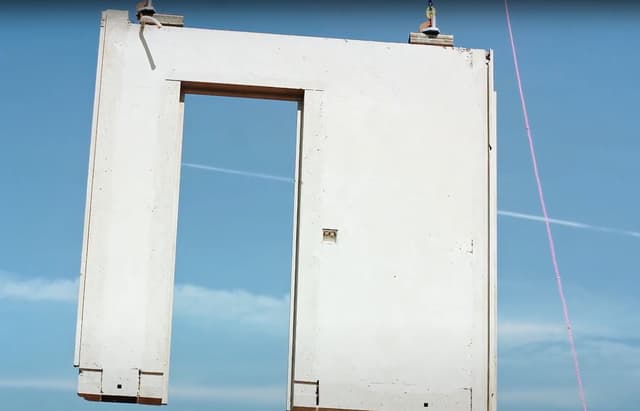
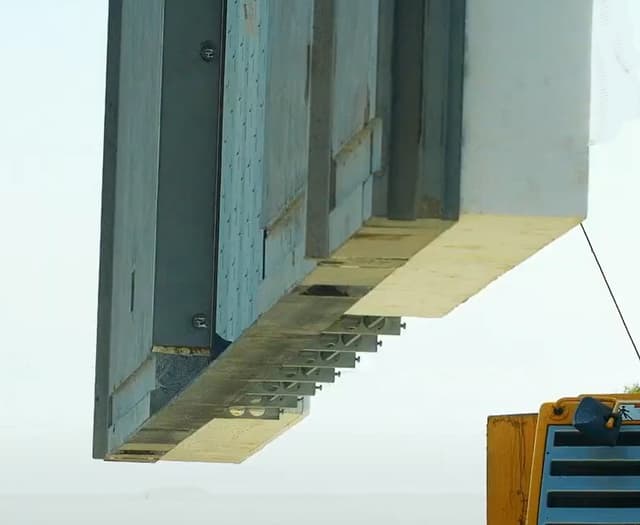
Photos from the construction of a single-family home.
5. “One of the main benefits of SMARTPANEL is its excellent insulation. How is it possible that there’s almost no need to heat in the winter and the interior doesn’t overheat in the summer?”
SMARTPANEL achieves excellent temperature stability thanks to its heavy reinforced concrete panels and exterior insulation. The heavy material accumulates heat and gradually releases it, thereby stabilizing the temperature throughout the day. Thick thermal insulation without thermal bridges reduces heat loss in the winter and prevents overheating in the summer.
Windows with interior blinds protect the interior from overheating. As a result, SMARTPANEL maintains a stable temperature without major fluctuations throughout the year.
6. “People also often ask about the sound insulation in modern buildings. How does SMARTPANEL perform in this regard?”
It is important to distinguish between the SMARTPANEL system itself (i.e., reinforced concrete structures) and the interior residential partitions, which are constructed using dry-construction technology.
SMARTPANEL provides superior acoustic insulation thanks to the high mass of the structures and well-executed details—such as separated utility shafts and a robust construction of ceilings and floors.
Thanks to the use of gypsum fiber boards, which significantly outperform standard drywall partitions, sound attenuation reaches 44–48 dB, which reliably exceeds the standard for inter-apartment walls (42 dB).
Compared to traditional drywall (30–35 dB), gypsum fiber boards are nearly twice as heavy and six times stronger, so they better dampen noise and resist vibrations. Furthermore, their monolithic joints ensure that no cracks form and that acoustic properties are not compromised.
In the Rezidence U Tvrze project in Malešice, these partitions were used precisely because of their high acoustic insulation and strength, which allow for undisturbed living even in a busy household.
All load-bearing and partition structures used exceed the standard requirement by 6 to 10 decibels, which means four to ten times greater sound energy attenuation than required by the standard.
7. “What does the future of the construction industry look like? Do you think SMARTPANEL could become the dominant material for modern construction?”
The future of the construction industry is moving toward faster, more precise, and more environmentally friendly technologies.
The key will be to reduce material waste, lower energy consumption, and ensure healthy and comfortable living conditions for occupants.
SMARTPANEL already offers solutions that meet these requirements: fast and precise construction, minimal heat loss, the absence of thermal bridges, and a long service life without the need for repairs. Moreover, it has proven itself not only in single-family homes but also in larger projects, such as Rezidence U Tvrze in Malešice.
The SMARTPANEL system meets the most demanding user requirements, both in terms of aesthetics and usability. The luxurious design with clean lines is still uncommon in the Czech Republic.
However, when I showed the final appearance of our buildings to architects in Saint-Tropez or Italians, for example, they were thrilled. For Czech builders, SMARTPANEL may still seem a bit ahead of its time, but people quickly get used to the best.
In the future, I expect that prefabricated components like SMARTPANEL will become the standard, especially where fast, high-quality construction without compromise is needed. Production automation, modern materials, and better insulation will play a key role in ensuring that buildings are comfortable, durable, and environmentally friendly.
SMARTPANEL has enormous potential in this regard; it’s already proving that it can meet the demands of modern construction more effectively than traditional methods.