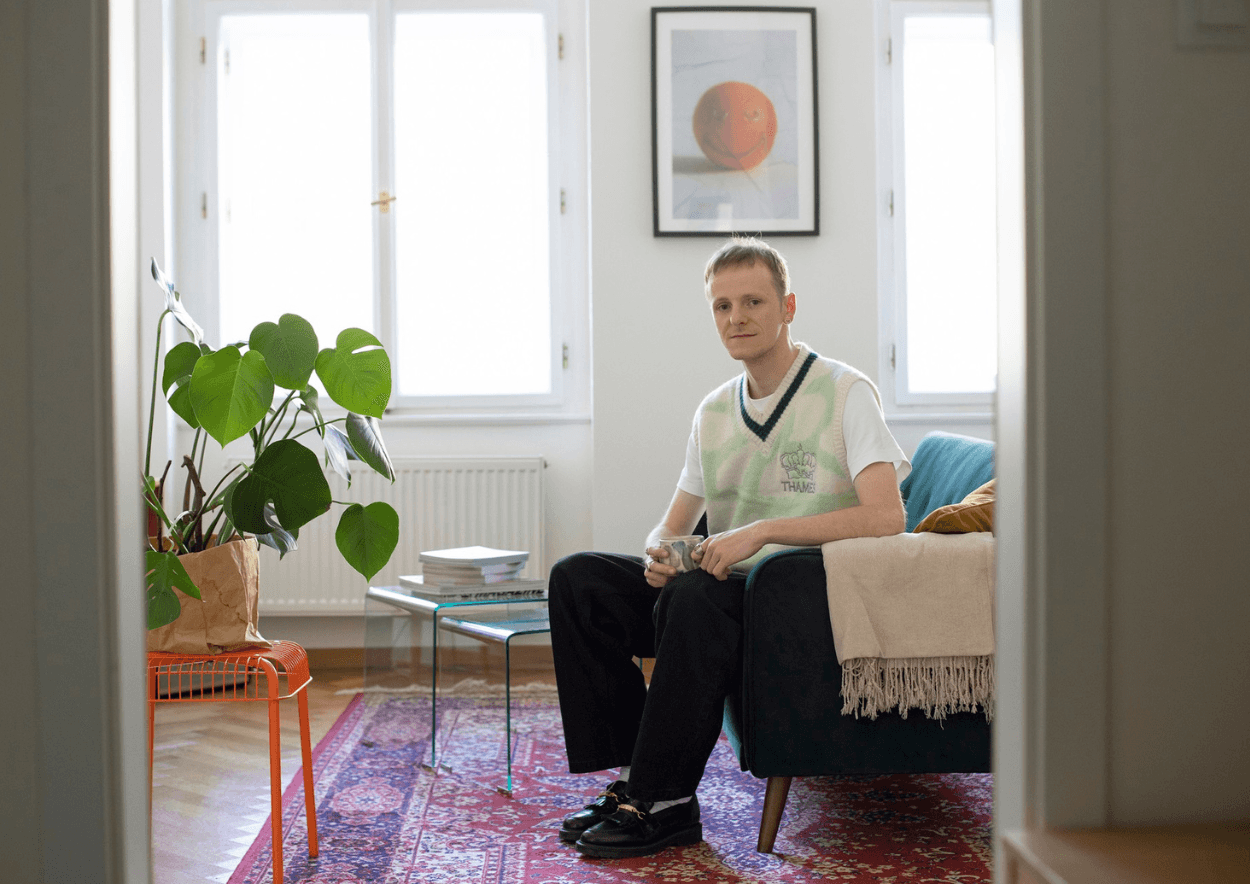
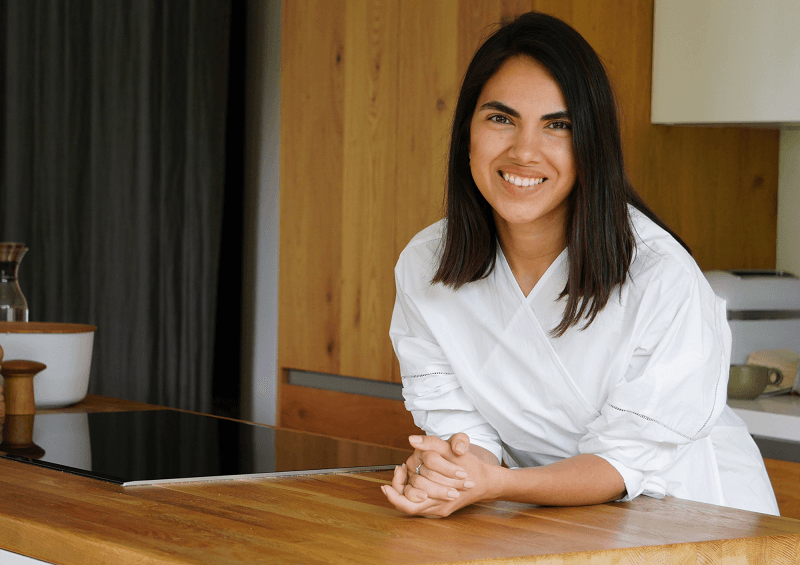
You grew up in Barcelona, Berlin, and Kyiv in a large Russian-Spanish-Bolivian family, and now you live with your Czech husband and children in Prague. How do you like life here and the city’s energy?
For the first few years after we moved to Prague, I went for walks every day and marveled at its beauty. I had a small child, so I’d head out with the stroller. I was pleasantly surprised by how accessible Prague is. With the stroller in one hand and a coffee in the other, I’d discover interesting places like galleries, new cafés, design shops, and showrooms. I was fascinated by every historic building—its origins and architectural details. I was really passionate about it back then. I sought out old, dilapidated buildings with historical value, took photos of them, and hoped they’d soon be restored. And indeed, in many cases, they were. After the renovation, I’d take another photo of the building, creating a collection of “before and after” photos.
In addition to your fascinating background, you also have an impressive professional focus. You’re a trained interior designer, a Feng Shui specialist, and a KonMari® home organization consultant. What path in life led you to this unique combination?
When I was fourteen, I decided I wanted to design interiors. To find out if I’d really enjoy it, I started taking evening design classes that lasted about nine months. As soon as the course ended, it was clear to me that this was the right path. So I decided to study interior design in college. At that time, I was also interested in Feng Shui, which I saw as another way to expand my knowledge of interior design. I fully immersed myself in it a few years ago and spent an entire year studying at the Czech School of Feng Shui in Prague. I completed all four levels and eventually earned accreditation in English from the New York School of Feng Shui. I discovered the KonMari® Method through a book about “The Life-Changing Magic of Tidying Up.” After reading it, I started using this method at home, and when I saw how well it worked, I decided to enroll in the course for certified consultants so I could share this know-how with others.
 In the Czech Republic, you’re one of four certified consultants of Marie Kondo’s method. How difficult was it to obtain this certification, and what did the process entail?
It wasn’t easy at all. After completing the course, I spent another half-year working with practice clients. Each one was different. Sometimes I had to draw more on my design experience; other times, I had to delve a bit deeper into psychology. With each of them, however, I was truly delighted by the changes this brought to their lives.
The purpose of Feng Shui in interior design isn’t just aesthetics, but also improving relationships and fostering harmony among the people who spend time in the space. What kind of feedback do you get from your clients—do they notice such changes in their lives? What’s the most interesting change you’ve noticed?
Yes, Feng Shui is primarily about the harmonious connection between a person and their interior. At the same time, it’s important for the client to feel that the changes made will make their life easier and make sense to them. I’m always so happy when, after the changes are made, a client tells me that they now actually seem completely logical to them.
Surprisingly, the biggest changes in clients’ homes occur even with the smallest adjustments. In one family that had been trying unsuccessfully for years to have a child, we removed all items from the health zone, and today that family has two healthy little daughters. A great example of how Feng Shui works is also a large hotel project in the Tatra Mountains. To bring in a greater flow of energy and money, I shifted the main building by a few meters. And even though last year was quite difficult, the investors managed to sell all the available apartments very quickly.
How many visits are usually needed to fine-tune an interior according to Feng Shui, and how many for organizing a home using the KonMari® method?
The advantage of Feng Shui is that we can work with clients remotely. All I need is a floor plan, details about the household’s daily routine, and the birthdates of all its members. Of course, the ideal scenario is one visit before work begins and another after it’s completed. KonMari® takes a more personal approach. One visit is needed for each of the five categories.
Can you tell us which of your services is most popular among clients?
Business clients are most interested in the Feng Shui method, which can bring more revenue to their businesses. I do a lot of analyses for hotels, restaurants, and even beauty salons. Private clients, on the other hand, are more interested in KonMari® decluttering. Sometimes they want to combine it with a refresh of their home, so I help them choose colors, fabrics, or furniture.
What’s the biggest Feng Shui mistake you encounter in your clients’ homes?
The guiding principle of my work is that I don’t judge an interior from my own perspective, but from the client’s. What matters is what works for them. For me, there’s no one-size-fits-all rule for what’s wrong. I don’t want to create cookie-cutter interiors; instead, I aim to respect and preserve the character of each home. But I do have one piece of advice: Get rid of all broken or non-functional items. They carry negative energy that has no place in the home, so it’s best to remove them as quickly as possible.
Is there any universal advice that can take the harmony in an interior to the next level—and that anyone can put into practice, even today?
Absolutely. Open the windows and air out the space thoroughly, put scattered items back where they belong, buy a fresh bouquet for a vase, and throw away five items that no longer align with your lifestyle. For example, those dumbbells you’ve been meaning to use for years, or that ten-year-old suit that doesn’t fit you anymore.
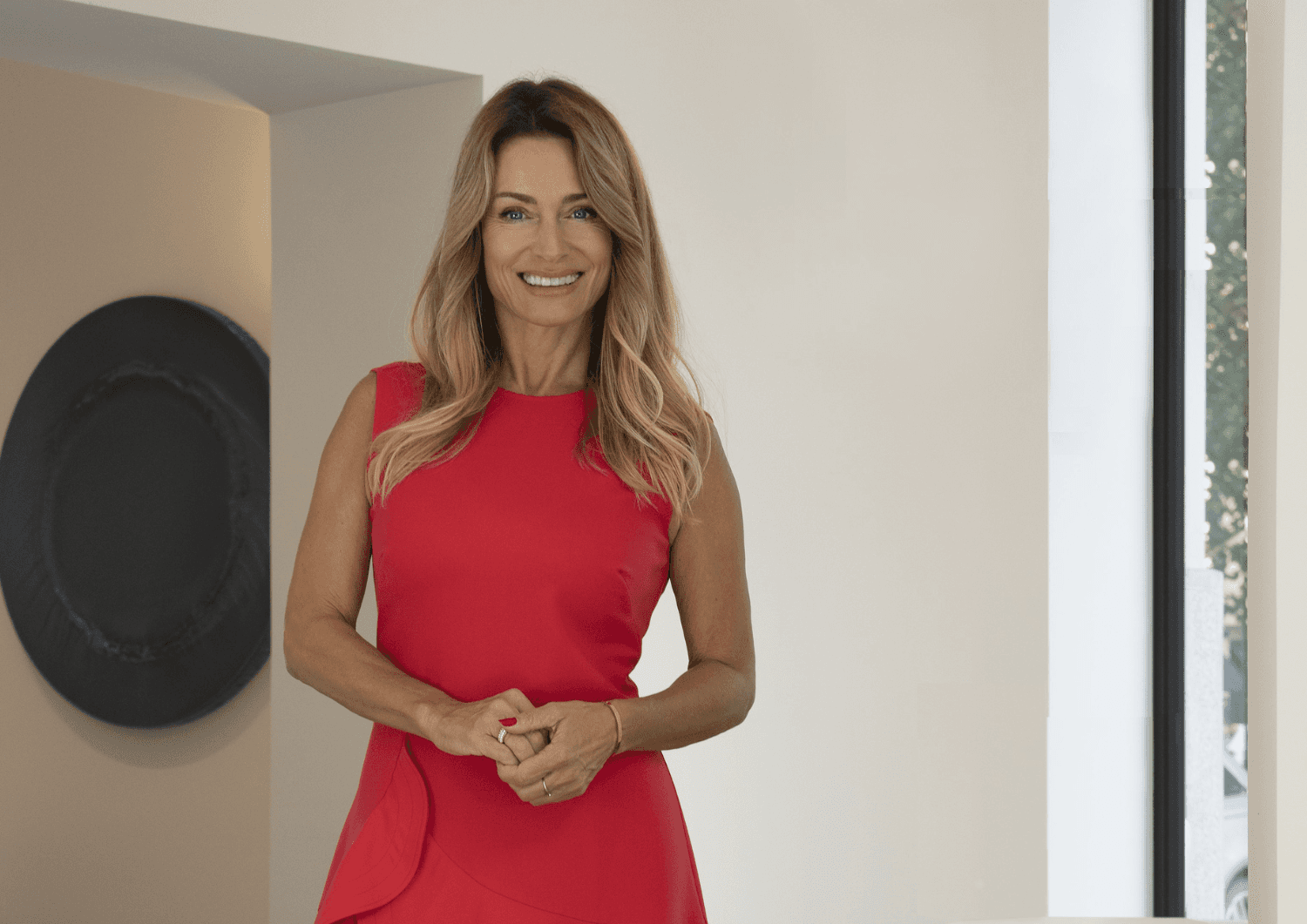
Maria Rochas
She grew up in Barcelona, Berlin, and Kyiv in a large Russian-Spanish-Bolivian family. Her journey into Feng Shui design began in 2005 when she came across a book on harmonious living, meditation, and inner peace, written by a renowned Feng Shui specialist.
Studying interior design at university then allowed her to better understand the structure and processes involved in interior design.
Shortly after graduating, she met her Czech husband, and the two settled in Prague. There, she graduated from Otakar Chochola’s Feng Shui school. Around the same time, she discovered Marie Kondo’s book, whose philosophy is now also an integral part of her life. You can follow Marie Rochas’s work on her official website or Instagram.