Where exactly is the line between the premium and luxury segments?
From our perspective, it’s primarily about the location of the property. Every major city has areas that are more or less interesting and highly attractive at any given time. This is also true for Prague.
So do you see this more as a geographical or local distinction, and does the saying “Location, location, location” apply here as well? Yes, that’s one definition that could be used.
Does the clientele change over time?
Yes, we’ve noticed this intensely, especially over the last ten years—primarily in terms of their expectations. At the same time, the professionalism of our brokers is also growing. We’ve been in the market for thirty-three years, and during that time we’ve gained a wealth of experience with various clients and their needs.
And are the needs of today’s demanding clients different from those of previous years?
Yes, but it’s more about how you guide the client through the entire process. Our company provides a truly high level of service. For us, the foundation is an exceptionally high level of communication, transparency, and a personal approach.
We’ve been providing this to people ever since we entered the market, and clients have come to expect it from us.
Recently, however, a new group of clients has emerged that requires a slightly different approach than those we’ve been accustomed to so far. This is a new, affluent community consisting of influencers, podcasters, YouTubers—generally people from the younger generation. We’re noticing this change primarily in communication, which is why we’re actively seeking ways to adapt and expanding our team with real estate agents who will be able to communicate effectively with this group—whether online or offline. We consider effective communication in the real estate world to be absolutely fundamental. The younger generation naturally prefers the online environment, but that still means high-quality care, personalized service, transparency, and reliable communication. It’s important that our clients feel that we truly care about them.
You mentioned modern technologies—how do you think they’re transforming the real estate world?
Significantly. The changes have been most evident in the area of marketing. Today, most marketing activities take place online—both for resale properties and for new development projects. Personally, I like numbers, and the online world gives us a huge advantage in this regard. It offers precise and measurable data. Our company has fully adapted to this trend. We have our own in-house marketing department as well as an in-house consulting department that monitors the market situation. These teams are absolutely crucial to us. For over thirty-three years, we have been systematically collecting market data—not only on the transactions themselves but also on client behavior. Thanks to this, we are able to conduct detailed analyses internally, without having to rely on external databases or other sources. LEXXUS NORTON prides itself on its consulting department and advisory services, which developers have always been happy to take advantage of. What new projects are you currently working on? The list would be quite extensive, because at the moment we have thirty-eight projects on the market, and a number of other projects are in the planning phase. It is precisely this planning phase that is crucial to a project’s success. It always takes place in close collaboration with our consulting and marketing departments. We focus on successfully combining a high-quality marketing strategy with an attractive location—and, of course, a high-quality project itself. And that is precisely where our expertise lies. If a developer is willing to listen to our recommendations and can respond to the data we provide, the chances of the project’s success increase significantly. Does this mean that
You don’t start selling a development project only when a developer comes to you wanting to sell it, but rather you’re involved from the very beginning—for example, when the land is being purchased?
Yes, that’s the ideal scenario, but we also get involved in projects at later stages of preparation or sales. We work with developers with whom we have long-standing relationships and mutual trust. These partners often carry out acquisitions through us. They purchase land, seek out opportunities for new projects, and consult with us on what makes sense to build in a given location and for whom. Together, we determine the mix of units, the use of materials, and appropriate technologies, which naturally affects the overall price level of the project. Thanks to our years of experience, we know exactly what mix of units and what price per square meter will make a project successful in the market. According to our case studies, we can help a developer increase profits by up to twelve percent “simply” through proper pre-sales preparation. The result is a project that is marketable and attractive not only from an urban planning and social perspective but also commercially. And that, ultimately, is the main reason why a developer or investor gets involved in a project.
Let’s return to the locations that determine whether a place is considered premium. Do you see any area in Prague that is poised for development similar to what Karlín once experienced—a neighborhood that is certainly premium today but certainly wasn’t long ago?
At this point, we all probably recognize that Prague 5, specifically the Smíchov Railway Station area, will be a very interesting location. For example, we’re currently selling the Na Plzeňce Residence there; in the first 10 months of sales, 70 percent of the apartments have been sold. Holešovice is also experiencing a huge boom in terms of housing, but when we look at the potential for further growth, it isn’t as significant. It is expected that changes might come more within the framework of the City of Prague’s zoning plan, such as the possibility of constructing taller buildings. That is one of the key things that, in my opinion, should change, because we are currently lagging significantly behind in this regard. For projects that have building permits, we’re often talking about buildings with eight to ten stories. If we look at Munich, Berlin, Vienna, Paris, or London, buildings with twenty to thirty stories are commonplace there. In Prague, we have a limited resource—land—which cannot be expanded, yet the potential to build taller is not yet being fully utilized.
Which part of Prague—or perhaps a specific project—are you personally most excited about right now?
Personally, I like projects best where an existing historic building is taken, its original elements and character are preserved, but at the same time, a completely new spirit of modern living is infused into it. In my opinion, renovating apartment buildings in this sensitive way has enormous potential. When you walk through Prague, there are still many buildings here that would deserve a similar approach. As an example, I’ll mention the Rezidence Norská project, which has been sensitively renovated—modern, yet respectful of the building’s original character. Personally, as a lover of architecture, I feel that Prague lacks bolder projects. Some are emerging in Karlín and are interesting, but they often lack distinctive originality, character, and the courage to pursue something truly unique—whether in terms of architecture, sustainability, the use of technology, or the integration of green spaces and the surrounding neighborhood. In my opinion, this is an area where there is still room for development, and where Prague could benefit significantly. In the real estate market, there are periods when there is an oversupply—when there aren’t many buyers—or, conversely, when there is huge demand and nothing to offer.
What kind of period are we in right now?
Since the second half of 2024, we’ve actually been experiencing something on the real estate market that hasn’t been seen here in a long time: a stable environment. Interest rate trends are now relatively predictable. We can anticipate how the Czech National Bank will react, and after a period of major fluctuations caused by the pandemic, the war in Ukraine, and other events, we now know how Czech banks typically respond to these changes. At the moment, interest rates are hovering around 4.5 percent, a level that can be considered stable and acceptable in the long term. Unfortunately, the shortage of real estate remains a problem, especially in Prague. This is a long-standing issue closely linked to the slow process of obtaining building permits and other administrative burdens. We could debate whether there is a shortage of larger apartments or smaller units, but the fact remains that demand in Prague and the Central Bohemian Region is still very strong. Rising real estate prices are reverberating throughout the market.
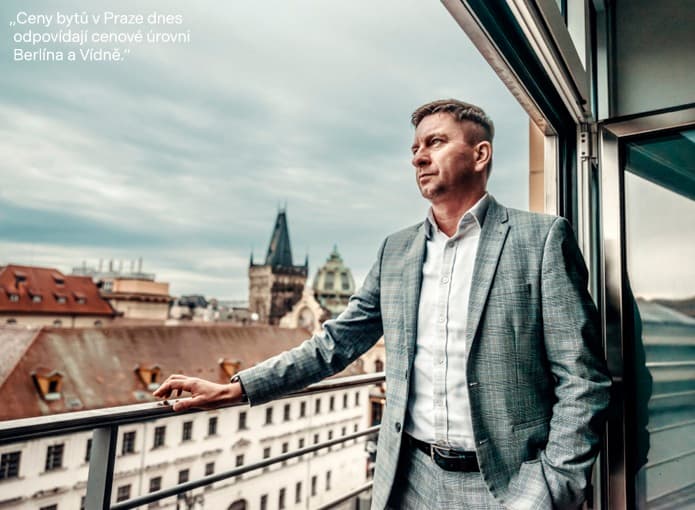
For years, there has been talk that Prague has some catching up to do compared to the Central European region or other European cities of similar size, but is there still room for prices to rise here today? Apartment prices in Prague today are on par with those in Berlin and Vienna. Compared to Munich, there is still room for growth, but I would look north of us, toward Poland—Warsaw, for example. There, prices per square meter are significantly lower than in Prague. This isn’t to say that Czech developers or investors should move to Poland. Rather, it’s about keeping an eye on trends around us. Poland is interesting in that it is able to carry out construction more cheaply and efficiently and can serve as a valuable source of inspiration for us. Especially with regard to how they handle processes and costs. Statistics confirm that the market is on the rise. In the first nine months of this year, the number of property registrations in the Prague land registry rose by six percent year-over-year, while the value of residential units increased by roughly fourteen percent. We often discuss prices exceeding two hundred thousand crowns per square meter with developers who are planning projects a year or two in advance. For boutique projects in specific locations, prices can even exceed three hundred thousand crowns. These projects have a small number of units; they are unique and one-of-a-kind, and thanks to our knowledge of our clientele, we know that they will often be sold out even before construction begins, because it is precisely the uniqueness of the location and the opportunity to own something exceptional that is immensely attractive to clients.
Magazine Address
Text: Kateřina Ehrenbergerová | Photos, visualizations: Ondřej Košík, LEXXUS NORTON