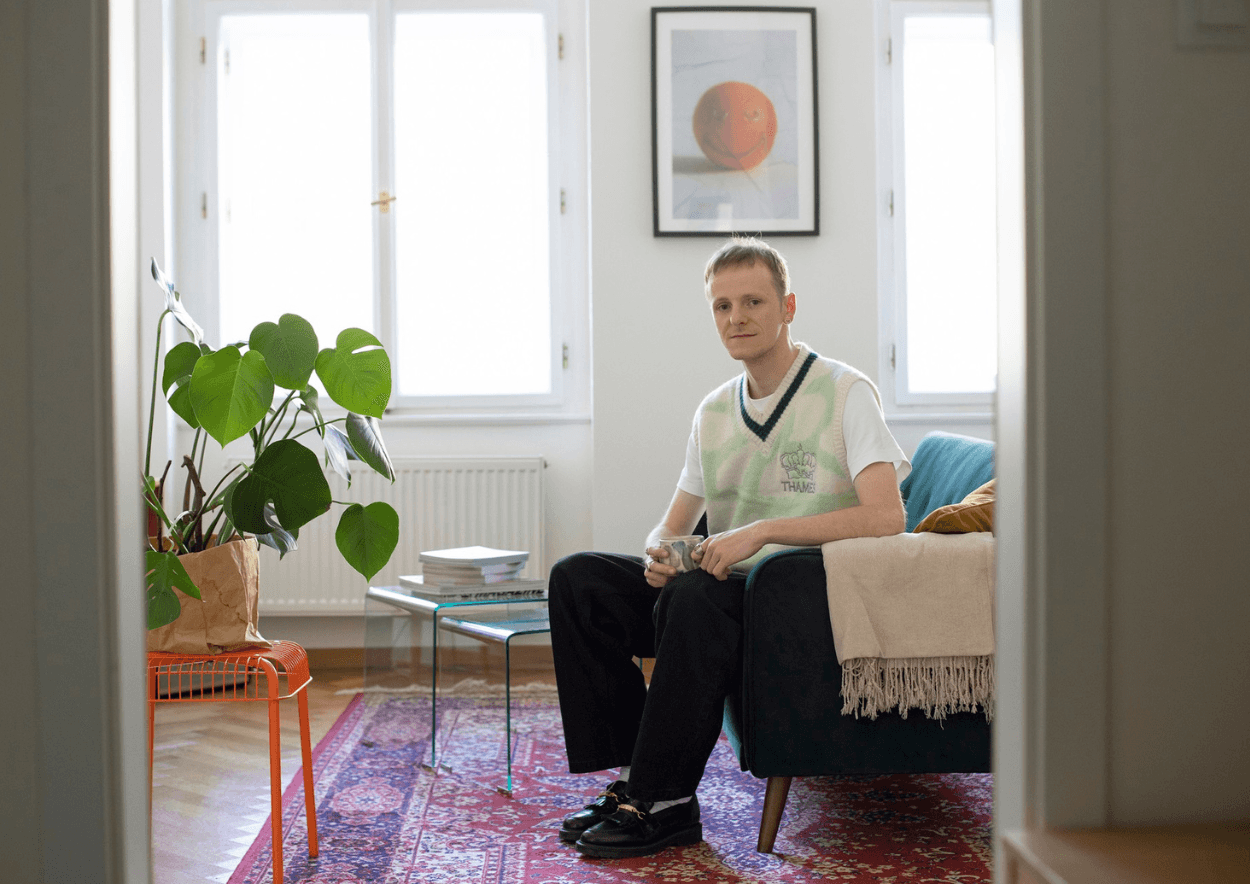
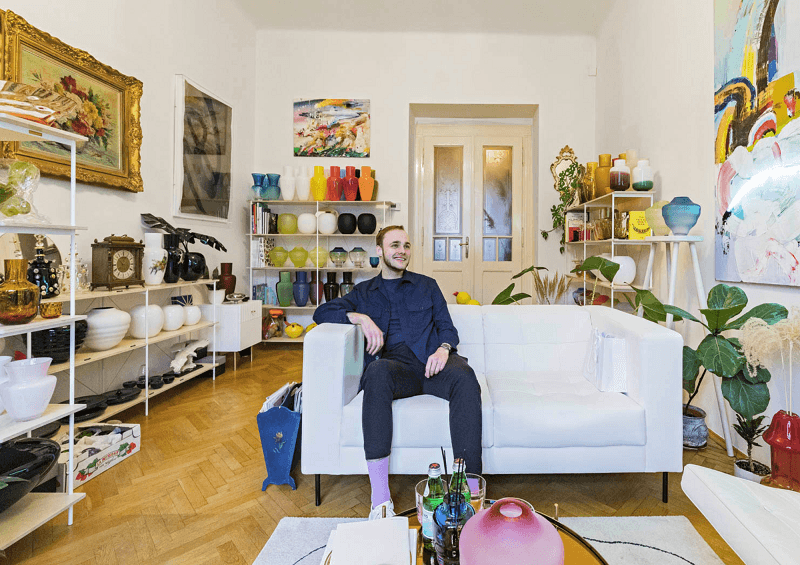
František Jungvirt in his living room, which also serves as a showroom. Photo: LEXXUS NORTON.
We’re meeting at your apartment in Nusle, which you also use as a showroom and studio. How did you come up with the idea of combining these three functions into one?
I’d liked the idea of combining them long before I actually put it into practice. It’s not really anything new, after all. In the past, many artists lived and worked in residential studios like this. The main reason I decided on this concept was its practicality. Before, a friend of mine who’s also a designer and I rented a beautiful space in Karlín that served as a showroom for our work. But the rent wasn’t exactly cheap. We spent everything we earned back then just to pay for it. Because of that, I also had to cut back and rent a smaller apartment than I needed. So after a while, it seemed much better to rent a larger space where I could not only live comfortably but also work and present my work to clients.
How do you like living in such an unconventional home?
I like it here. A lot of my friends say they couldn’t function this way. But since I work with glass, I spend three to four days a week on the road. I have seven to ten workshops that I have to visit. So I don’t have to worry about falling into a rut. It’s also a big advantage that when a client calls to say they want to stop by the showroom in half an hour, I no longer have to drive from one part of Prague to another like I used to, and I can use the time I save more effectively.
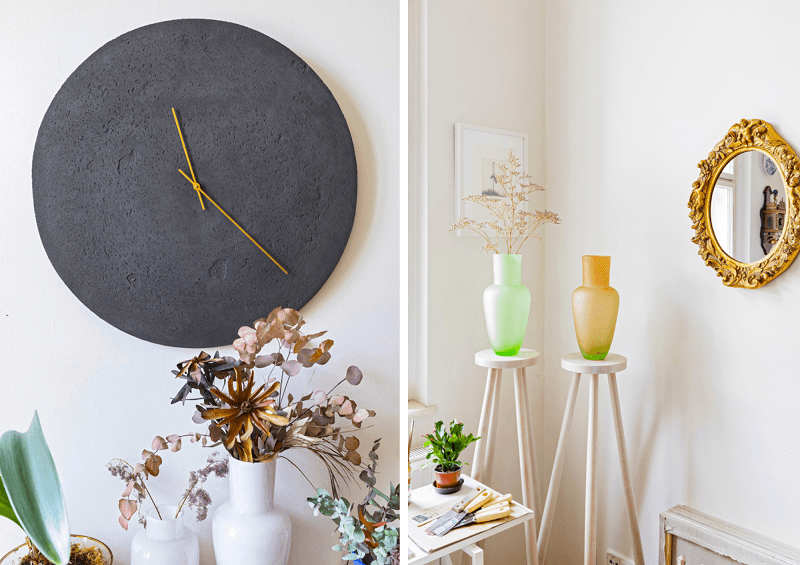
You’ll find artistic nooks throughout the entire apartment. Even in the kitchen, which partly serves as František’s workshop. Photo: LEXXUS NORTON.
Was it difficult to find an apartment that met your requirements for running a residential showroom?
It certainly was, and it took quite a while. Fortunately, my friend Lukáš helped me with the search. My main requirements included high ceilings, hardwood floors, and an overall historic character. I also needed it to be as bright as possible and to have at least three rooms. I wanted to use one of them as a reception area for clients, another as a painting studio, and the third as a separate sleeping area that clients wouldn’t have access to. It was also essential for me that it be close to the city center and that the apartment be rented unfurnished.
And finally, you discovered this beautiful apartment in Nusle. How do you like living in this neighborhood?
Before I moved here, I lived in Prague 1, not far from the National Theater. At first, Nusle seemed too far from the city center to me. But now I view this change as nothing but positive. It takes me ten minutes by tram to get to Národní třída, and when I need to drive somewhere, I know I won’t have any trouble finding parking when I get back home. That was a real problem in the center of Prague. There are also plenty of interesting places in the neighborhood that are just as good as those in the center. Come to think of it, I live better here than I did in “District 1.”
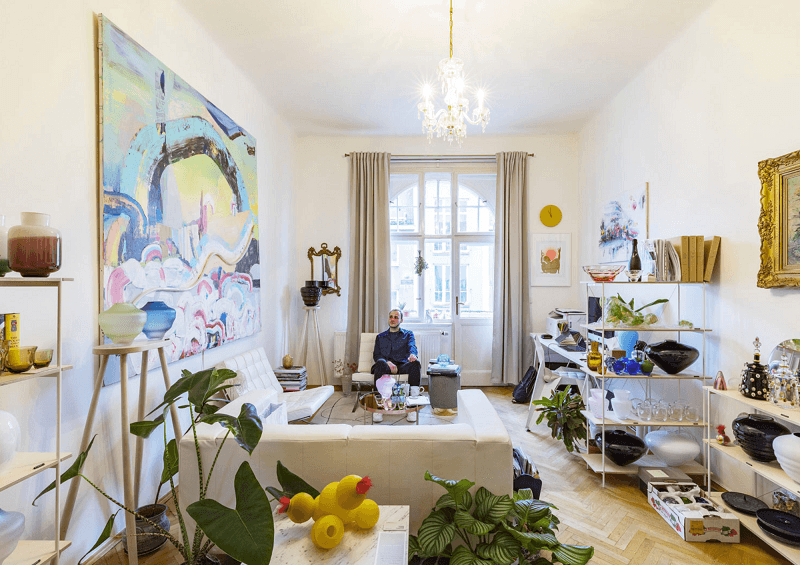
In addition to his own work, František Jungvirt’s showroom also features paintings by contemporary artists. Photo: LEXXUS NORTON.
If your home didn’t include a showroom, do you think you’d have as many art objects in it as you do now?
I like to surround myself with art, so I think so. I have a lot of old ceramics here, artworks by my classmates, canvases by Czech painters, and traditional cut glass. That’s a nod to my grandfather, who worked as a glass cutter. I think it’s important to live immersed in what you do. To be in constant contact with quality books, paintings, and art in general. You know, all designers talk about how we should buy quality things. But not everyone lives that way. For example, I love the tradition of Czech glass, which is why I don’t have a single glass in my apartment that wasn’t made here.
I understand. And I think you can really feel that in your home. What criteria do you use when selecting the art pieces you decide to display at home?
As I said, context is important to me. If I like a piece of art but don’t identify with the artist’s views and attitudes, I won’t display it at home. I wouldn’t enjoy looking at it. I know the vast majority of the artists whose works I have at home personally, and I like them. Partly because I see the spiritual values of their creators in their work. For example, you have a painting by the artist Lucie Jindrák Skřivánková, with whom we have a lot in common. We both work with color, our works often have a strong expressive quality, and we get along well on a personal level, too.
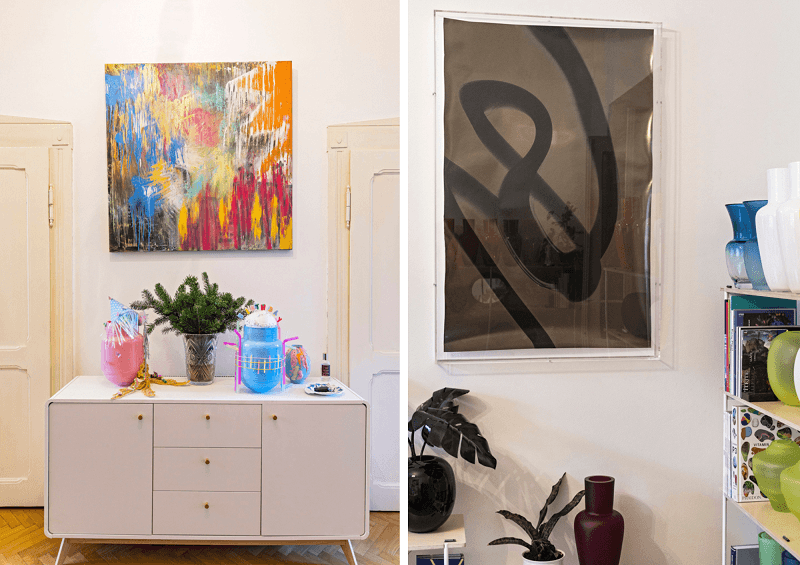
Photo: LEXXUS NORTON.
Where do you spend most of your time at home?
Definitely in my studio, which doubles as a showroom and living room. When I’m not sitting at my desk, I’m sitting in an armchair or on the couch, thinking about my work, which surrounds me everywhere here. I’m lucky that I don’t perceive my work as “work,” so it doesn’t bother me that I live in it nonstop.
The KLIMCHI brand, where you’re the creative director, recently collaborated with the traditional Czech furniture brand TON. I saw two chairs from their collection in your kitchen. What’s your relationship with TON?
I really like the TON brand. We actually have a lot in common. A strong connection to tradition, craftsmanship, and a significant international reach. So the collaboration between KLIMCHI and TON made a lot of sense. And I think you can see that beautifully in the final photos, which turned out incredibly well.
You’ve also worked on a number of collaborations with interior designers and architects. And not just in the Czech Republic, but also in Slovakia, Germany, and Italy. How did these collaborations come about?
Actually, it was all the idea of photographer Peter Fabo, who shoots interiors and architects’ projects. He knew that many of them were looking for accessories to further complete the interior and enhance its overall feel. So far, we’ve done the most photo shoots with the Prague-based architectural studio 0,5 Studio. Peter showed them my portfolio, which they liked, so we subsequently agreed to collaborate. We’ve already photographed three or four of their projects this way. In Slovakia, I’m collaborating with the excellent designer Romi Klimeková, with whom we’ve furnished several apartments using my glass.
Originally, it was supposed to be just decoration for a photo shoot, but the owners liked my pieces so much that they decided to buy them. In Germany, interior designers Danilo & Paolo reached out to me themselves to collaborate, and in Italy, it was Gaia Piccolo. More collaborations with interior designers and architects are in the works.
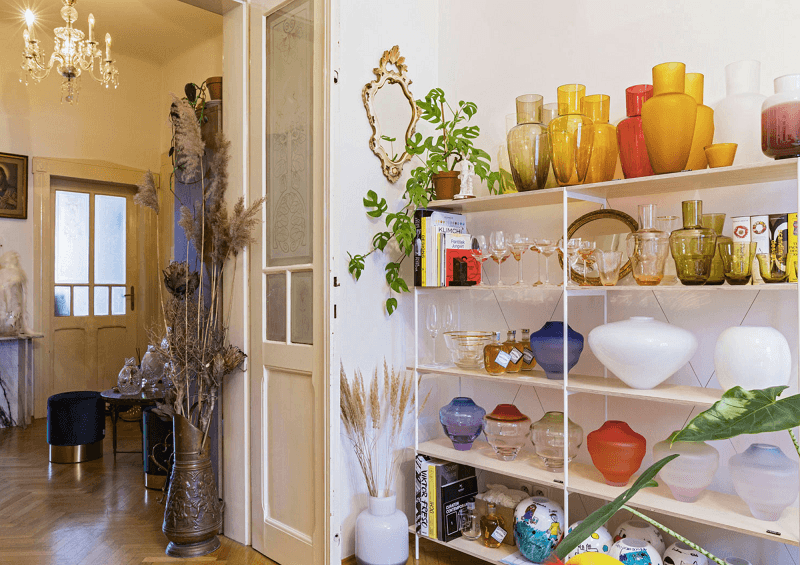
Photo: LEXXUS NORTON.
Is any of their styles so close to your own that you’d reach out to them to design your own interior?
It would probably be the guys from 0.5 Studio. I know them best; I’ve seen several of their projects, and I really enjoy their approach.
What would your dream home look like?
I really like light-filled homes with an almost purist design—ones that “breathe” and are surrounded by beautiful nature. I’d definitely want to have one huge, light-filled space where I could work and exhibit my work—a kind of private gallery setting. That’s exactly the kind of environment where I feel most at home.
František Jungvirt
Glass artist, designer, and glass painter František Jungvirt (*1996) studied glass painting at the Secondary Vocational School in Třeboň and is a graduate of the glass studio at UMPRUM in Prague. He currently creates under his own eponymous brand, frantisek jungvirt. In his work, he most often draws on traditional references to Czech glassmaking, to which he brings a fresh perspective. With each piece, he strives to push the technical and visual boundaries of the field. In addition to designing functional objects, he creates art objects, installations, and limited-edition glass series. Since 2020, he has served as the artistic director of the glass brand KLIMCHI. You can follow František’s work on Instagram or his official website.