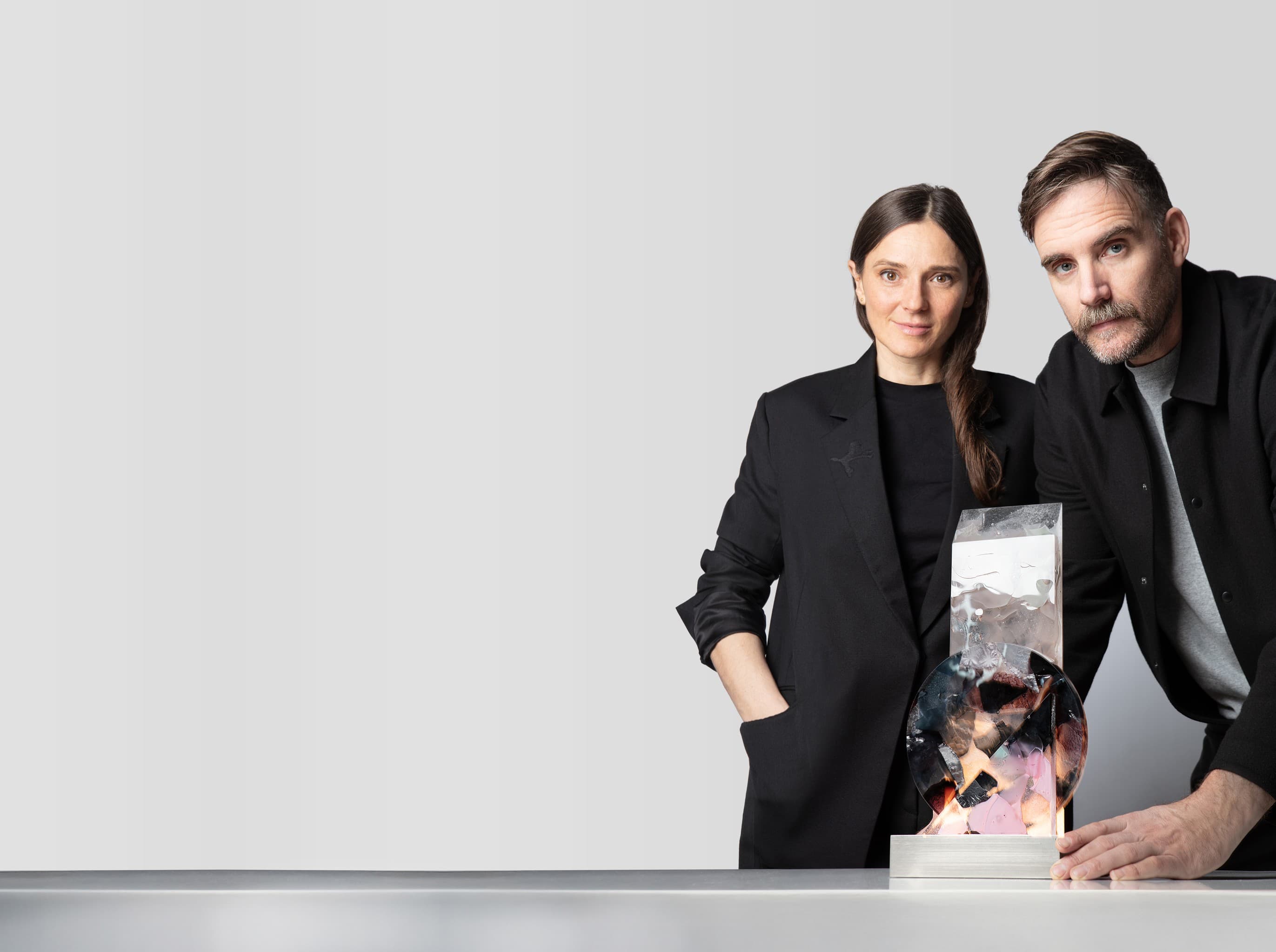
The founders of the Dechem studio—designers Michaela Tomišková and Jakub Janďourek, who are both creative partners and life partners—are the creators of the award for the 10th anniversary edition of the Interior of the Year Awards. Photo: Kristina Hrabětová
Your iconic Bandaska vase was a well-thought-out design that almost entirely excluded the element of randomness, whereas working with slabs made from remelted glass shards practically embraces randomness as a concept. What prompted such a shift in your artistic approach?
We love to experiment in our work; we’re always exploring the boundaries of working with glass. We particularly enjoy alternating between elements of randomness and meticulously crafted forms. For the Interior of the Year award, we combined these two approaches into a light fixture that is thoughtfully shaped; we created the material with a vision of the final form, while anticipating that randomness would play an integral part of the process.
What led you to use waste glass shards, to which you breathe new life through your designs?
Probably the need to work with glass even after it’s been broken and to extend the life cycle of the product or object. To start with sand and not stop at shards. Also, the search for new ways to process glass, as rising energy costs have made working in a glassworks very expensive. Upcycling is an integral part of contemporary design, and we’re very happy about that.
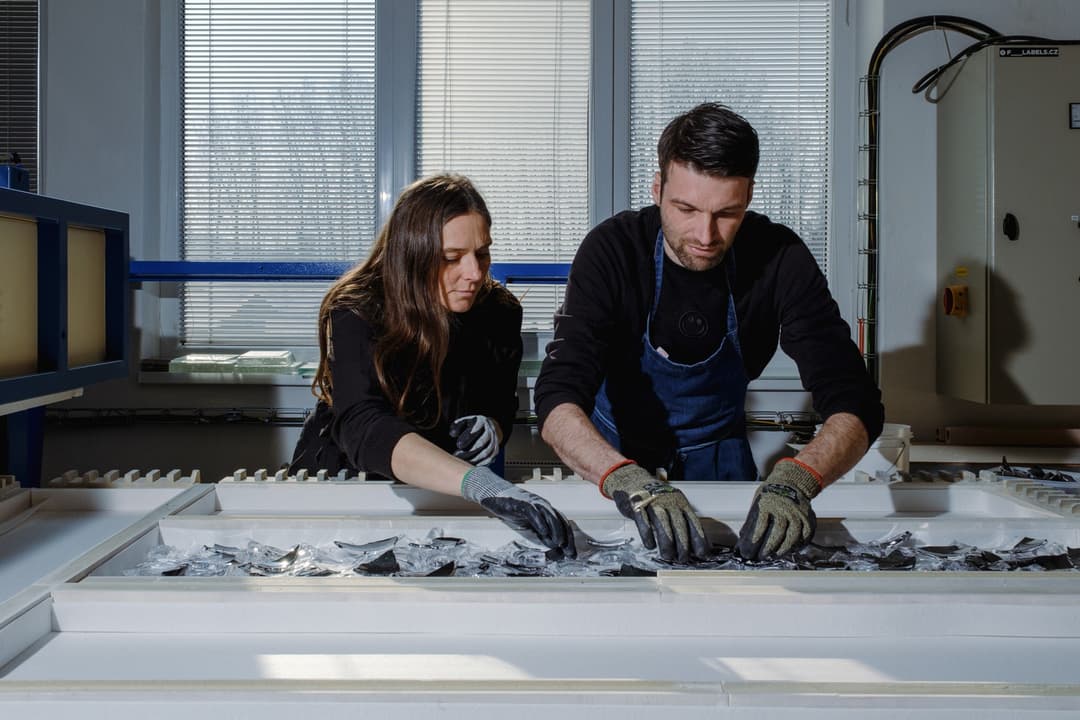
The fused glass panels were produced at Kolectivs Ateliers in Nový Bor. Co-creator Michaela Tomišková filled the mold with crushed shards herself, in collaboration with Michal Ullrich, head of the Slamping and Fusing Studio. Photo: Natálie Kubenková
You’ve named your technological process—or rather, the resulting material—Fragmentglass. What kinds of things can be made from it? What do you most enjoy designing with it?
We’ve just finished a new Fragment Line light fixture for the Bomma brand, and in our own work, we use Fragmentglass for unique objects, tabletops, interior panels, and wall-mounted light fixtures. From small items like wall hooks to large glass interior panels. We also work with different panel thicknesses; once the edges are polished, you can “peek” into the wonderfully magical world of glass.
This year’s Interior of the Year award takes the form of a geometric interplay of three shapes. In your view, how specifically does this light object evoke an interior, or perhaps the process of its creation?
The entire award is like a miniature of architecture; it’s a view through polished surfaces into the depths of the universe. It’s like the pieced-together parts of every creator’s projects. We wanted to create an award that gives space to your imagination.
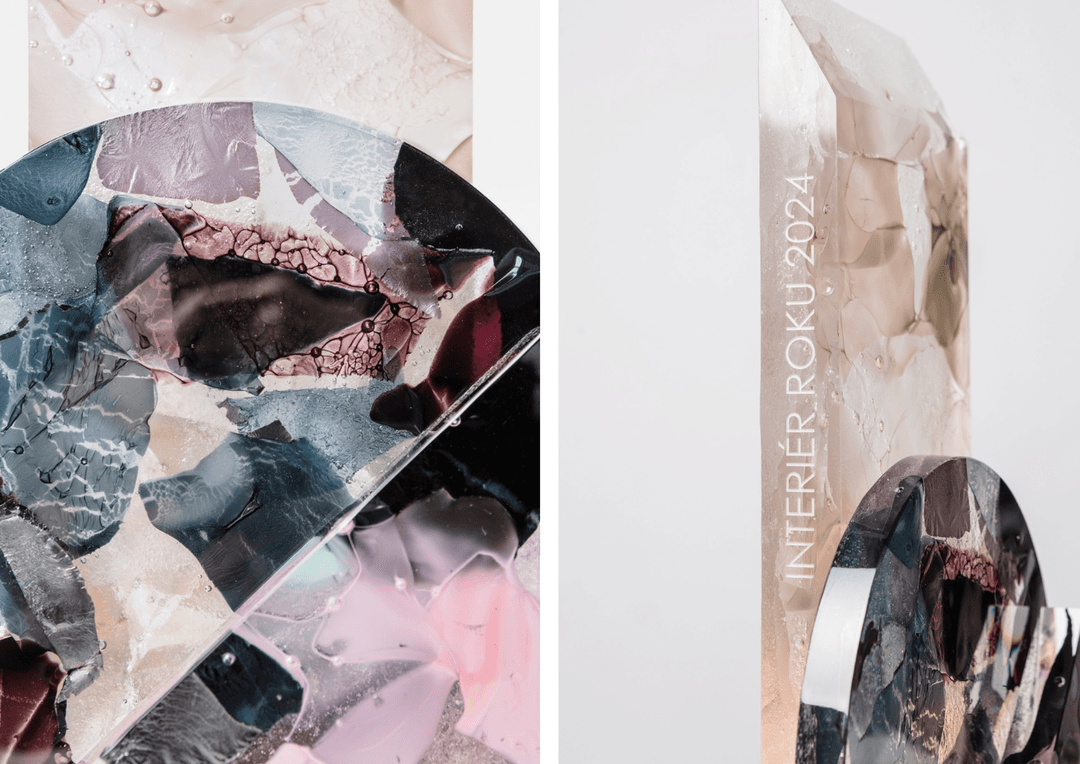
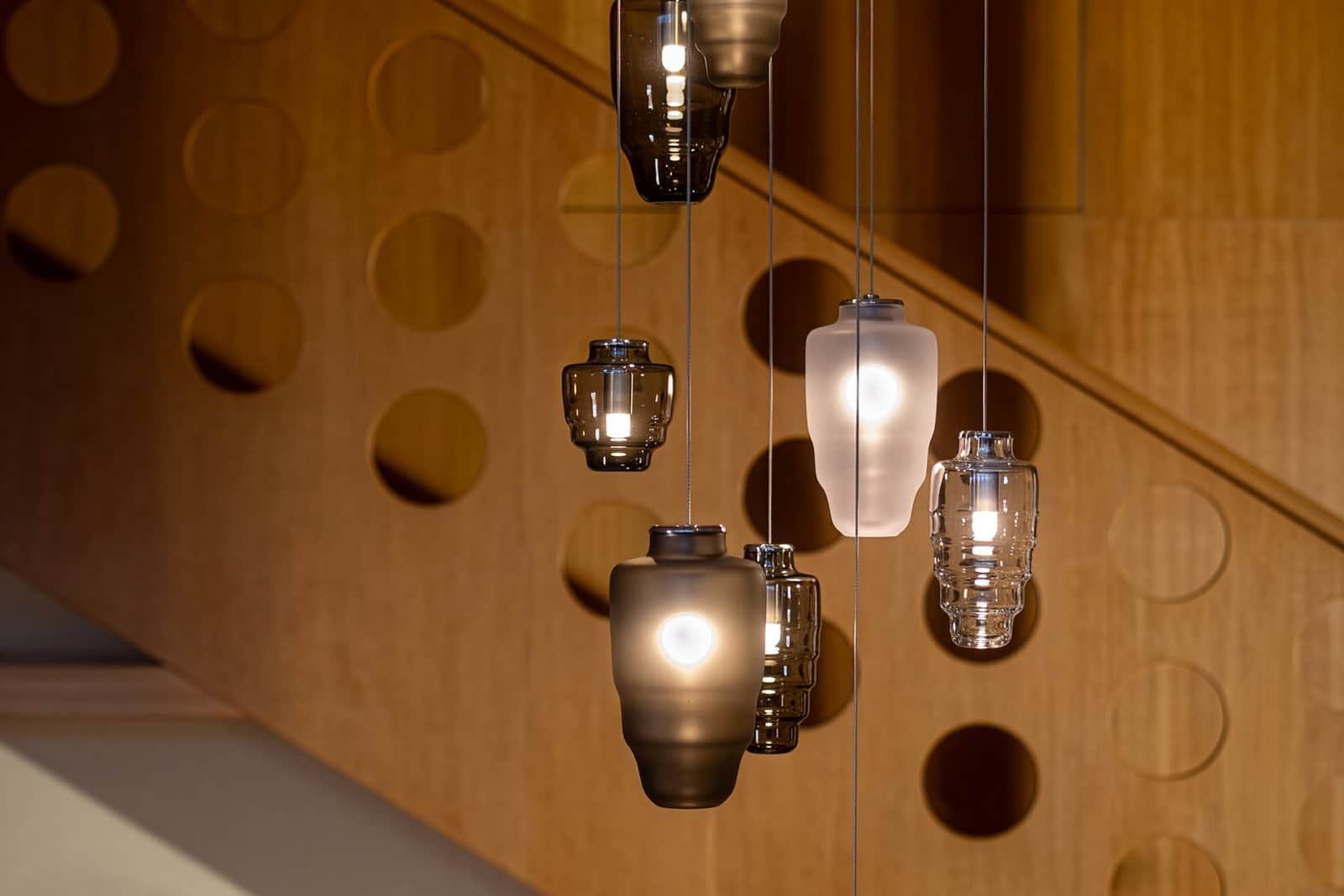
The award for the tenth anniversary edition of Interior of the Year consists of geometric glass surfaces created by assembling scrap shards. The designers from the Dechem studio have named this technology “Fragmentglas.” The object is backlit and serves as a metaphor for architecture as seen through the designers’ eyes. Photo: Kristina Hrabětová
During the production of the Interior of the Year awards, you personally shattered the glass, poured the shards into molds, and influenced the production right up to the very end. You seemed incredibly focused and enthusiastic—even euphoric. Do you enjoy this approach more than when you “simply” hand over a design to production?
I think we both really enjoy the production process itself.
I spend a lot of time at the Holešovice studio, and I often feel that I need to connect with the material itself—to get involved in the production process or at least assist. All of these experiences find their way into the final design. You can always tell from every product just how much passion and knowledge of the material the designer brought to it. Personal experience really elevates our work.
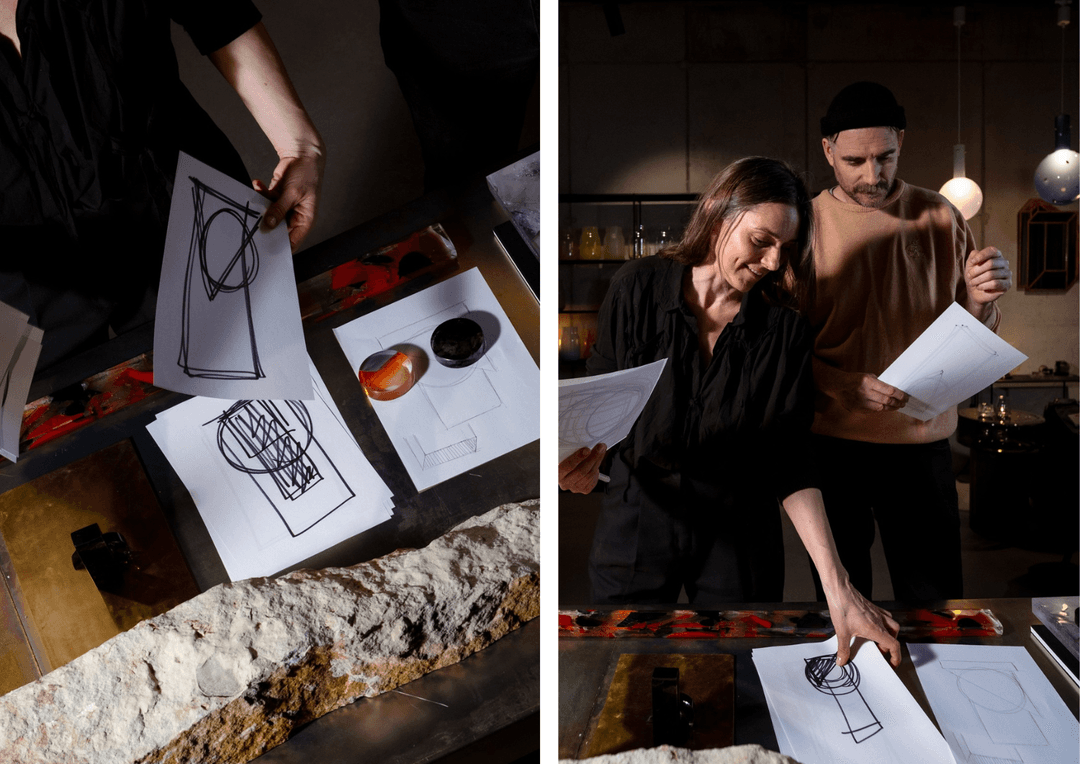
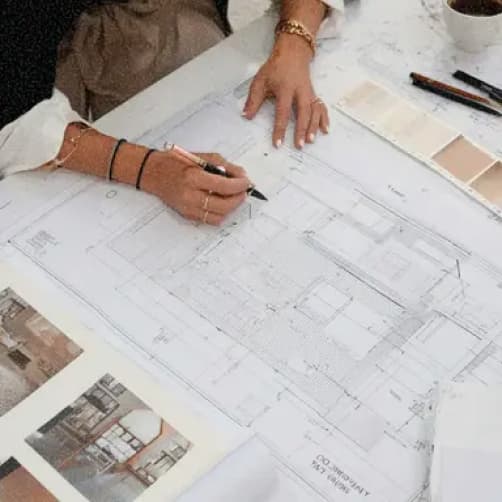
The final design was preceded by a whole series of sketches. Photo: Natálie Kubenková
Studio Dechem is made up of a large team, but the core is the two of you—as both a creative and life partnership. How does this “co-authorship” actually work? Does one of you focus more on form while the other handles the technical side, or is there a creative dialogue behind the scenes?
Creative dialogue is an integral part of how we work. Sometimes we simply trust the other person’s choice of form or technology, and other times the whole team searches for the right concept and then its form. We’ve been working together for a long time, and I think we know each other’s needs, inspirations, design language, and creative process very well and deeply. Respect—and sometimes letting things flow naturally—is our path to working well together.
You regularly exhibit at the Salone del Mobile in Milan or, for example, in Paris. What do you consider your greatest success to date?
For me, the greatest success is definitely that DECHEM brings us joy and sustains us, that we love going to work, and that we have many great plans and fulfilling projects ahead of us. I’m truly grateful for that.